
3. SCAD Day 3 - Angiograms & Smaller People

To be honest, I had no idea what an angiogram even was,
nor did I have any idea how ‘mind-blowingly’ painful it could be.
Particularly for smaller adults.
What Is a Coronary Angiogram?
Coronary angiography is used to study the blood vessels that supply the heart muscle. It may be used if you have any of the following conditions:
heart attack – a serious medical emergency where the supply of blood to the heart is suddenly blocked, usually by a blood clot
angina – chest pain that occurs when the blood supply to the heart is restricted
coronary heart disease - when your heart muscle’s blood supply is blocked or interrupted by a build-up of fatty substances in the coronary arteries (the blood vessels that supply the heart)
An intravenous (IV) line will be inserted into a vein in your arm. It can be used to deliver sedatives or any other medications required. Electrodes (small, metallic discs) are also placed on your chest to monitor your heart during the procedure. A blood pressure monitor will be attached to your arm.
A catheter (a thin, flexible tube) is then inserted into one of your arteries, usually either in the groin or wrist.
“An angiogram is a generally safe and painless procedure.”
(Information from NHS Scotland nhs inform website)
‘a painless procedure’…. I beg to disagree.
The above info is from the NHS Scotland website - and has obviously not been written by someone who has actually had an angiogram. Or, if they have, they are not a smaller person. They’re probably a man….
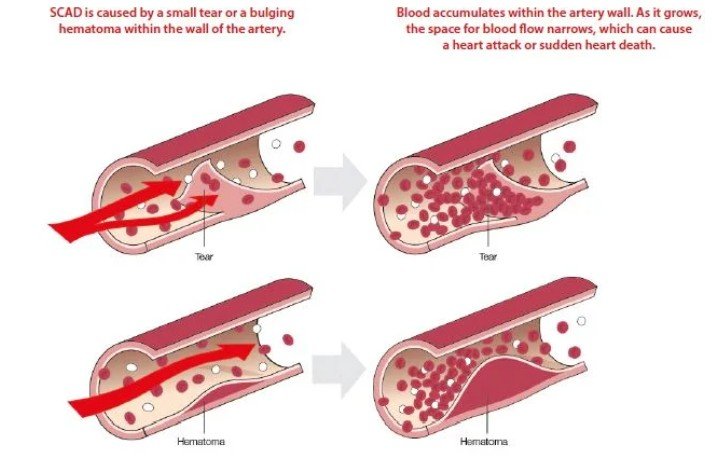
In addition, yes, a heart attack can be caused by a blood clot BUT S.C.A.D. heart attacks are caused by either a tear and/or bruise in the artery which then blocks the artery, not a blood clot.
Having an adult-sized catheter inserted into a child-sized artery is excruciatingly painful.
Believe me.
Common Reactions To The Above…
Why didn’t they have a small enough catheter for you? I mean, they’ll do angiograms on children at some point, surely?
Sure. But I’m in an adult hospital not a children’s hospital.
Now. to those of you whom I haven’t met IRL, I’m not teeny!!
I’m 5 feet 4 inches, weigh approx. 55-58kg but my wrists and ankles are small.
The angiogram doctor, wrapped his finger and thumb around my wrist and said,
“our problem will be finding a catheter small enough for you. You must tell us if it is too painful, we’ll give you more pain medication Jill”
Grand.
So why don’t they know about tears in the heart arteries too?
Because 80 - 90% of SCAD heart attacks occur in females and the medical profession think that males and females are exactly the same physiologically. They assume that we all have the same type of heart attack i.e. blocked artery type.
To Be Crystal Clear
having a catheter that is bigger than your artery inserted into said artery is
NOT freakin’ “painless”
I am not squeamish. As an ex-dancer, gymnast, woman… I can put my body through hell, declaring “everything is fine”, whilst I pass out with pain.
After being injected with pain relief and then a dye, ‘Mr Angiogram’ began with the catheter…
Holy crap that was horrendous. I tried to bear it, I really did, but my legs were tying themselves around each other, my body squirming in pain, I was crying unsure how long I could carry on.
It’s basically like trying to squeeze a straw up your forearm, via an artery and that artery ain’t as big as the straw.
However, thankfully Mr Angiogram was compassionate! Hooray! A compassionate healthcare worker unlike Mr. Colonoscopy who was the devil incarnate - but that’s for another time…
He immediately stopped as I began squirming and crying in pain, ordered more pain meds be injected and gave them a minute or 2 to work (& for me to catch my breath)
Then he began again, and it was bearable.
I was off my trolley on drugs but, not in screaming pain - again, hooray!
The Positive - In Hindsight
These guys KNEW about SCAD!
‘Mr Angiogram’ said, and I’m quoting,
“there is a type of heart attack that affects mostly younger women who tend to have no ‘normal’ risk factors [ ] but we’ll see what we can see on the images”Both of the (younger) male ‘dudes-who-do-angiograms’ were already thinking of SCAD, they were already looking for it. I was very lucky in that respect.
They found it! The tear in my artery I mean, not just my heart (golly that would concerning if we were celebrating Mr Angiogram ‘finding’ me heart)
Once the catheter reached my heart, there were murmured discussions as it plied its’ way into my heart, then one of them said, “there it is!”
The Negative Outcome - for many
Still, in 2026, if anyone has a heart attack, the medics are expecting to find blockages (atherosclerosis) and, if they can’t see any, 2 options may occur:
Worst case scenario - you have no blockages, therefore you’ve not had a heart attack and you’re sent home.
2nd worse case - you have no blockages but “we know you’ve had a heart attack, but we don’t know why.”
You’ll receive medications and advice for heart attack rehab.
but will be none the wiser as to why or even what happened.
For SCAD patients and a majority of female cardiac patients
As the medics are only looking for blockages, if there are none visible, you’ll be deemed ‘well’ and will not receive any treatment
A woman may well be deemed to be experiencing stress & anxiety - and will not receive any treatment
If they DO see a tear in the wall of an artery and they HAVE heard of SCAD, a woman may only receive cardiac treatment as if she DOES have blockages. Which is incorrect treatment.
Additionally, if the issue is in the small vessels of the heart, angiograms cannot even see them!
This is important because disease of the small vessels is more common in women than in men.
Angina, a disease of the small vessels can cause heart attacks, cardiac arrest and can be fatal.
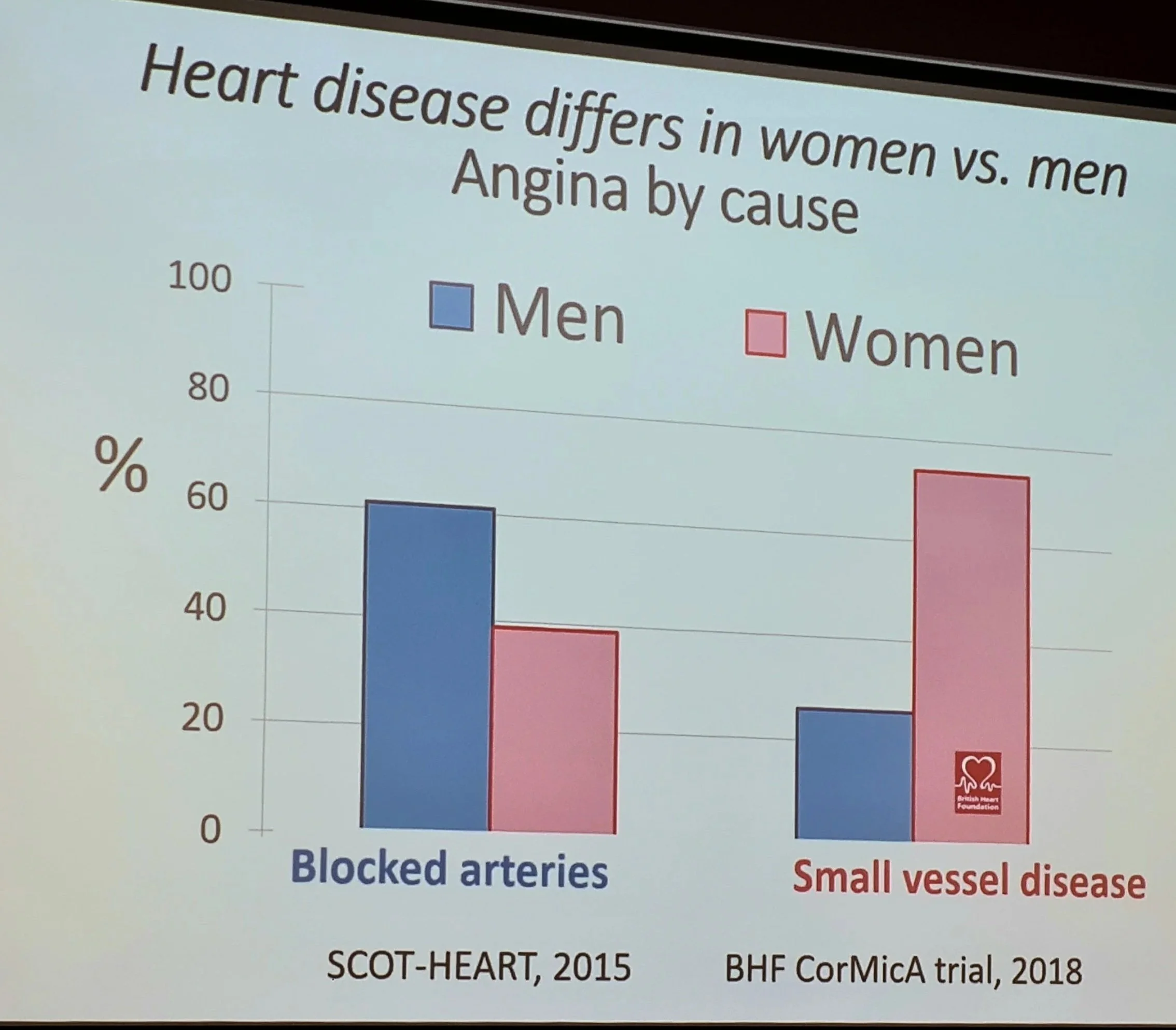
Image presented by Prof. Colin Berry at a research meeting - Sept 2024
Remember
approx. 90% of SCAD heart attack patients are women
Post Angiogram
“You have a beautiful, clear, healthy heart.
We can see the dissection though, which explains why you’ve had a heart attack”
A hard, plastic cuff is then attached around the wrist, to stop the blood spurting I imagine, then you’re taken back up to the ward.
Then, more pain! Jeez…
As the pressure in the artery builds up, due to the cuff being on, the pain… good God, and they have to loosen the cuff very slowly, in case.. well, you know, the spurting blood thing.
Again, more tears.. soz… but then it’s off, yea, but my arm remains very, very painful for the next few days.
Then I’m Kicked Oot!
At 21:30 I am ‘allowed’ to leave hospital, after the angiogram that afternoon.
Some nurse comes into my room, gives me 3 different types of medications, a letter and a see ya later.
I have no idea what the SCAD thing is, no idea if it will happen again, no idea why it happened, I am very confused as they said I had a beautiful, clear healthy heart and now my arm hurts as well as my chest.
But it’s Covid yea? So they need the beds I suppose and, seeing as it’s 9.30pm there won’t be any doctors for me to ask any questions anyway.
OK.
Let’s just get the hell out of this nightmare and go home.
I’ll work it out myself as per bloody usual.
Summary
an angiogram will only be painless if
a) the catheter is smaller than your artery
b) the clinician is good at their joban angiogram will not be able to diagnose issues in the microvessels of the heart
you can have a beautiful clear healthy heart and still have a heart attack
cardiology is a male dominated profession.
If a man can’t see it then there’s nothing wrong with you.I was lucky with the clinicians who performed mine.
Coronary Heart Disease (CHD) kills more than twice as many women as Breast Cancer in the UK every year,
and is the single biggest killer of women worldwide.
Despite this, it’s often considered a man’s disease.
The British Heart Foundation, Women & Heart Attacks.
SCAD is when a tear or bruise develops in a coronary artery that prevents normal blood flow.
This can cause: a heart attack, heart failure, cardiac arrest
and can be fatal.
Current data indicates:
90% of patients are female with an average age of 44-53,
many of whom have no or few heart disease risk factors.
ECGs and O2 levels may be normal.
Assess troponin levels, repeating 4 hours later.
(NB. Results may be clinically insignificant)
For information:https://beatscad.org.uk/what-is-scad/https://academic.oup.com/eurheartj/article/39/36/3353/4885368